Tracking Air Pollution


As winter commences in North India, the presence of PM2.5 makes it to the headlines in New Delhi. Particulate matter, (PM) in particular PM2.5 is the classification of fine inhalable particles, with diameters that are generally 2.5 micrometers and smaller. In comparison, human hair ranges from 50-70 micrometers which makes the fine particulate matter, PM2.5 in this case, 30 times smaller in size and hence inhalable. Health and visibility problems are caused in New Delhi post-monsoon due to the burning of paddy in the states of Punjab and Haryana, India. The paddy is harvested during the month of October and wheat is sown swiftly after. The management of paddy stubble in the time interval between harvest and sowing of wheat is crucial. 

The wind carries the residue of the burnt paddy (PM2.5) through to Delhi and the city consequently experiences ‘very poor’ to ‘severe’ air quality levels during the winter months. The acceptable limits based on the health impacts of PM2.5 are shown in Table 1.
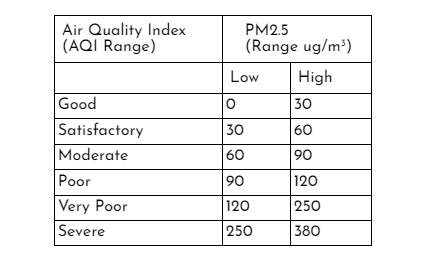
Table 1: AQI Range of PM2.5

Table 1: AQI Range of PM2.5

We created spatial data visualisations highlighting the deteriorating air quality in Northern India due to the burning of paddy, to accompany an article in Mongabay-India. The Mongabay article gives an insight into what stops the paddy from turning into biofuel - covering the technical, financial and official handicaps. A part of the article explored the mapping of paddy burning locations from September to November, 2021 and the PM2.5 mapping from October to November, 2021. 

In this post, we share how satellite imagery of PM2.5 was processed and animated to display the severity of air pollution by using ECMWF’s CAMS Global Near Real Time data from Google Earth Engine (GEE) data catalogue. The time period of 1st October, 2021 to 30th November, 2021 was chosen to highlight the PM2.5 levels post harvest-season.

First, a Daily-Means algorithm is prepared to aggregate data so that one day in the said time-interval has one output image of PM2.5. In this case, mean is used to aggregate the daily data into one image. At the end of this step, we have an Image Collection of 61 daily images with PM2.5 for each day (Figure 1).

Figure 1: Daily Mean algorithm

This image collection is then clipped to the desired extent (using the in-built clip function of GEE). The Daily-Means image collection data can also be added to the GEE map display panel using the Map.addLayer function. In this case, the mean function was used to display the Image Collection output in the Layers Panel.

Figure 2: Image Collection display

The next step is to create the animated dataset using the image collection. In this case, a scale bar, title and outline of state boundaries (Punjab and Haryana, India) of the image are displayed in the final animation. The scale bar is positioned by specifying its coordinates. Its maxima and minima labels, that is the PM2.5 levels as well as its style: font-size, colour, etc, can also be customised. At the same time, the title and its style are chosen and rendered. The outline of the required area which is captured in the animation is added next. The scale bar, title and outline are then blended into the Daily Means map using the in-built blend function of GEE. Next, the overall coverage of the extent of the animation is specified with coordinates-this extent subsumes the scale, title, outline and other add-ons of the animation around the actual map of interest. The visualization parameters of the animated dataset are then specified and printed to the console (Figure 3). The styling of animation felt a bit tedious as the arrangement of add-ons (scale bar, tittle, etc) is relative to the latitude longitude coordinates of the map of interest. Although it makes the dataset visualisation accurate, moving the add-ons needs careful calculations.

Figure 3: Animation display

The following animation (Figure 4) was used to visualize the impact of burning paddy in Punjab, Haryana and New Delhi, india.

Figure 4: Animated PM2.5

Although the intensity of pollution seems linked to the increase in the number of burning locations, there were some glitches in interpreting the scale of the data provided. Scale of the data varies from 0 to 0.1 ug/m3 according to the dataset provider’s unit during the said time-period for the concerned area shown in Figure 4. The actual scenario of PM2.5 levels in the air is evidently greater than the permissible limits. While we share the process of animating the PM2.5 data, we are trying to better understand its scale as well. 

It took around two days to piece the code together. While this was sufficient, a host of other options are available at ‘users/gena/packages’ (Figure 5) in the Script Manager section of the GEE code editor interface which can be harnessed to load more information on the animated dataframes based on the requirement. I hope to further explore this package for better application and visualization.

Figure 5: Package for animation

The animated dataset here shows us the change in air quality. While this gives us a peep into reality, we hope to see all paddy turn into biofuel soon. If you have any questions or comments, get in touch with us at contact@techforwildlife.com.

Persevering with PARIVESH

I have been signing petitions and participating in campaigns to stop the clearing of large forest areas for the construction of some major road or highway for almost a decade now. Clearing of forests also involves forced rehabilitation of tribal communities and of course the habitat loss for biodiversity. In 2016 and 2017, I naively sent emails to ministers to inform them why constructing a 6-lane highway through a tiger reserve would be a bad idea. Unfortunately, all of my letters and signature campaigns fell on deaf ears. In most cases, the agencies responsible for felling trees had already secured the clearances needed to do what they were doing, and those roads would eventually be built. The projects had already been approved by various authorities, including those who were responsible for protecting those forests in the first place, many months before the protests or petitions. I could only sit back and watch forests being destroyed in the name of development. The interaction between development and conservation, and the idea of attaining a balance between them (if that’s even possible) has always been of interest to me. Therefore in 2018, I decided to study infrastructure impacts on the environment as part of my master’s thesis. It was while conducting the research for my thesis that I came across an absolute goldmine of information on a website called PARIVESH: (Pro-Active and Responsive facilitation by Interactive and Virtuous Environmental Single window Hub). This is a web-portal launched by the Ministry of Environment Forests and Climate Change (MoEFCC) in 2018 which has a historic database of all new and old projects seeking environmental, forests or wildlife clearances, along with links to relevant documents and assessment reports. It also allows the user to track project clearances and review comments put forward by government officers. As a real-time clearance portal, This website seemed to be an honest attempt to bring about transparency in the approval process for development projects that require various environment-related clearances. Although not fully accessible unless one knew their way around on the website, it seemed to be a good start to know about projects beforehand. I assumed everyone in the conservation space, especially the groups who often initiated those petitions I had been signing, would be using the website extensively . I was glad about the existence of the portal and amazed with the government’s initiative to come up with it.

However, fast forward to a few months later in 2019. Whilst working with one of the leading conservation organizations of the country, I realized that the reality was that far from PARIVESH being extensively utilized by many people, it’s existence was not even widely known. This was a shock to me, to say the least, but it was also my chance to understand the PARIVESH portal and find ways to make use of the huge amounts of information it made available. This seemed like a fun thing I could do through which I could somehow revolutionize the entire process of advocacy for sustainable, wildlife friendly infrastructure in India. Naive, I know, but this was my first job ever.

I soon realized the revolution was not going to happen easily. The more time I spent on the portal the more I realized that while the government’s intentions for this portal may have been that it would make the clearance process transparent and efficient, the design, as implemented, would do just the opposite. I realized that there were a number of major issues with PARIVESH (either on purpose, or due to sheer ignorance) which made information on the portal inaccessible and unusable. For instance, anyone interested in learning more about a potential project must know some very specific keywords to find the project details via the available search options. For updates on the project, they would have to check the portal every day. The projects uploaded for approval would be in the last phase of project planning, with very little scope for any stakeholder to put forward their concerns and recommendations. Although there are some other government websites that allow one to look up new projects in the initial planning phases, those websites happen to be much more complicated than PARIVESH. One would have to be extremely patient to collate information from all of those. Moreover, PARIVESH allows the spatial visualization of projects uploaded on the portal but this useful function is not accessible to the general public. This GIS section is accessible to only government officers with state-authorized login credentials (as of October 2021). For everyone else, it’s a matter of skill, expertise and patience for they would have to download each spatial file individually before beginning any sort of spatial analysis. Finally, I cannot count the number of times the portal has just blocked my access to it, whilst in the middle of research about some upcoming problematic mining or highway development project, almost as if it knew what I was trying to get at!

Personally, having spent so much time just exploring the various buttons and functions of the portal, I believe that the only way for conservation organisations to use PARIVESH effectively is to have a person dedicated to the task. Their role would be only to monitor the portal and make sense of its information and processes to be able to effectively use it for any conservation purpose. However, it turns out there is an alternative. We can develop a better model, something that actually bridges all the gaps and limitations of PARIVESH, allowing for a smoother, more pleasant user experience. I did not know something like this could be done but, currently I am part of the team which is doing it! I am working with colleagues who have been as frustrated as I by the multiple badly designed portals and websites containing lots of crucial information for both development and conservation, lying there in inaccessible formats. We are all motivated by the vision to accomplish what the government may have initially envisioned – a user friendly, transparent and efficient portal which allows easier access to all the information on various development projects within environmentally fragile areas collated from different sources. This is something that I, as a PARIVESH user, wished existed for the past 3 years and it is absolutely exhilarating for me to be a part of something that might make it a reality. The portal would make discussions about upcoming projects in ecologically important areas more evidence-based and would allow for more effective stakeholder involvement. 


If you have ever tried to find information on PARIVESH or have signed petitions to stop the construction of roads which already had all the requisite clearances, the urgent need for the existence of a transparent system that we are building may resonate deeply with you.

Flowchart illustrating an user agency’s process in PARIVESH by Ashwathy Satheesan

Using Computer Vision to Identify Mangrove-containing pixels in Satellite Imagery

This blogpost has been written by a team of 3rd-year BTech students from PES College, Bangalore: B Akhil, Mohammad Ashiq, Hammad Faizan and Prerana Ramachandra . They are collaborating with us on a research project around the use of computer vision and satellite imagery for mangrove conservation purposes.

Mangroves are plants  that grow in salt marshes, muddy coasts and tidal estuaries. They are biodiversity hotspots and serve as nurseries for fish stocks. They also help in maintaining the quality of water by filtering out the pollutants and sediments. Mangroves can flourish  in places where no other tree can grow, which makes them important ecosystems that help prevent coastal erosion and provide protection from flooding and cyclonic events. Furthermore, mangroves have the highest per-unit area rates of carbon sequestration (Alongi 2012) among any ecosystem, terrestrial or marine. Despite the ecosystem services they provide, mangrove forests are among the most threatened ecosystems on the planet. Globally, we have already lost 30-50% of all mangroves forests (WWF Intl. 2018) in the last 50 years and mangroves continue to be cut at rates 3-5 times higher than terrestrial forests every year.

One part of the solution in the puzzle to better conserve mangroves is to better document and monitor their existence, and the ecosystem services that they provide. So far, Technology for Wildlife has used traditional remote sensing methods on satellite and RPA imagery to understand the extent of mangroves. Our team is experimenting with the  use of computer vision to detect mangroves in satellite imagery. Through this project, we hope to develop this technique and compare its accuracy with that obtained using traditional spatial analysis methods. We  are also interested in this project because of the possibility of implementing a machine learning model that could become better  at detecting mangroves over time. Finally, the prospect of creating an automated monitoring system that systematically evaluates satellite data and detects changes in mangrove cover could be a significant tool for the conservation of mangrove ecosystems, both in Goa as well as globally.

In the rest of this post, we will outline the methods we considered for this project , as well as our reasoning for our final selections. The three major categories of  methods we considered for this project are:

(i)Machine Learning approaches, 

ii)Deep Learning approaches and 

iii) Image Processing Techniques. 

The Machine Learning approach  includes techniques such as decision trees, which is an approach of vegetation classification done by matching the spectral features or combinations of spectral features from images with those of possible end members of vegetation types. Other techniques include K-Means and IsoData algorithms, both of which are unsupervised, easy to apply and widely available in image processing, geospatial information and statistical software packages. 

The Deep Learning approach deals with architectures such as classification using Siamese residual networks (SiResNet) in which a 3-D Siamese residual network with a spatial pyramid pooling (3-D-SiResNet-SPP) is used which learns discriminative high-level features for hyperspectral mangrove species classification with limited training samples. Other potential techniques which could be used for better training of the model is the Chopped picture method, where images are dissected into numerous small squares so as to efficiently produce training images, and Convolutional Neural Networks, which are a class of deep neural  networks, most commonly applied to analyzing visual imagery. One could also use Mask - RCNN, which is a deep neural network designed to solve instance segmentation problems in machine learning or computer vision algorithms. An architecture which can be used for segmentation is a U-net neural network which is a standard CNN architecture for image segmentation tasks.

Under Image Processing, the techniques available include Gabor Filtering (which is widely used in image texture segmentation) feature extraction (where we use Hadooop to extract features from large datasets) and the Colour based approach (it deals with methods like k-means clustering and colour extraction using HSV model), among others. 

Choosing an appropriate method depends significantly on the data available. For training our model we have used USGS EarthExplorer to download Landsat 8 images. Each image consists of 8 channels, containing spectral information across several different wavelengths in the visible and near-infrared portions of the electromagnetic spectrum. The samples used to train the model were labeled at the pixel-level i.e. each pixel in the sample has an attribute value.  These attribute values are binary in nature, with a value of 1 representing the presence of mangroves, and a value of 0 indicating the absence of mangroves. Due to the limited spatial resolution of Landsat images, direct visual interpretation is difficult. The criteria initially used to label the mask data were a combination of altitude values from SRTM data and NDVI values from Landsat 8 data. If a specific pixel meets the required criteria to be tagged as ‘mangrove’, then it is labeled with a value of 1, or else given a value of 0.  For future iterations, we’ll be developing a masking process that includes aerial imagery and more sophisticated spatial analyses.

The method we chose for our project is segmentation using a U-net neural network. U-Net is considered to be a standard CNN architecture for image segmentation tasks. Segmentation is similar to image classification but in segmentation instead of just classifying the image based on the object present each pixel is classified to belong to a specific class i.e. segmentation requires discrimination at pixel level. U-net was originally invented and first used for biomedical image segmentation. Its architecture can be broadly thought of as an encoder network followed by a decoder network. 

The encoder is the first half of the architecture. It is usually a pre-trained classification network like VGG/ResNet where convolution blocks are applied first, followed by  maxpool downsampling to encode the input image into feature representations at multiple different levels. The decoder is the second half of the architecture. The goal here is to semantically project the discriminative features learnt by the encoder onto the pixel space to get a dense classification. The decoder consists of upsampling and concatenation followed by regular convolution operations. Upsampling is done to restore the condensed feature map to the original size of the input image, therefore expanding the feature dimensions. Upsampling is also referred to as transposed convolution, upconvolution, or deconvolution.


The U-net architecture offers some advantages over other segmentation techniques. In U-net architecture, the network is input-image size agnostic since it does not contain fully connected layers. This also leads to a smaller model weight size, hence also making it computationally efficient. The architecture is easily understandable, and can be scaled to have multiple classes. Architecture works well with a small training set, due to the robustness provided with data augmentation.

Deep U-net architecture is employed to perform segmentation. Image augmentation is used for input images to significantly increase training data. Image augmentation is also done while testing and mean results are exported.We plan on using Tensorflow Keras with python and its libraries to build our model, which we’ll be running on real-world data.

If you have any questions or comments on our work, please reach out to us through the contact form on the website.